Programme-Presentation of the 2027 season
La traviata returns to the lake stage – Otmar Schoeck’s dramatic Penthesilea opens the festival on 21 July
Bregenz, 19 Nov. 26. A classic opera in an acclaimed production on the lake stage, a tragic love story of great intensity at the Festspielhaus and two highly unusual pieces of music theatre at the Werkstattbühne, in addition to the Opera Studio, orchestral concerts, chamber music and an array of events for young people – the Bregenz Festival from 21 July to 23 August 2027 has a fascinatingly diverse programme that explores different facets of human longing under the motto Perspectives on Desire.
Following an exceptionally successful first run, Giuseppe Verdi’s La traviata is returning to the lake stage. In the summer of 2026, all 28 performances were sold out, with around 193,500 people seeing Damiano Michieletto’s staging of the opera against the backdrop of Paolo Fantin’s monumental mirror wall, shattered into countless fragments. The tragic tale of the courtesan Violetta Valéry, whose desire for love and autonomy is shattered by social conventions, is set in Paris in the Roaring Twenties. The opening night of the production’s second run is on 22 July. Pietro Rizzo and James Sherlock conduct. Owing to high demand, the festival has been extended by one day to allow for 29 performances of La traviata in total. Approximately 195,000 tickets are on sale, two thirds of which have already been booked.
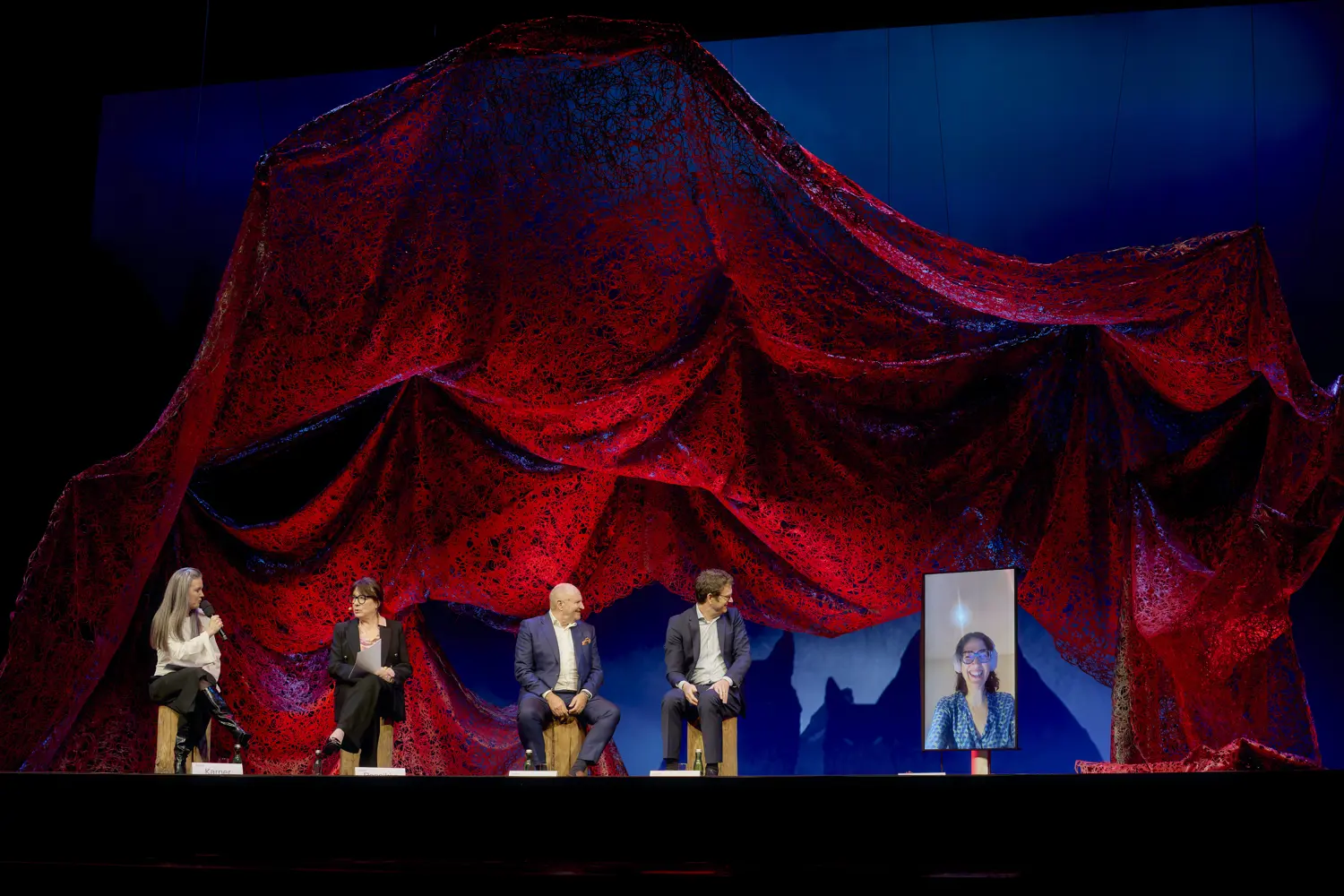
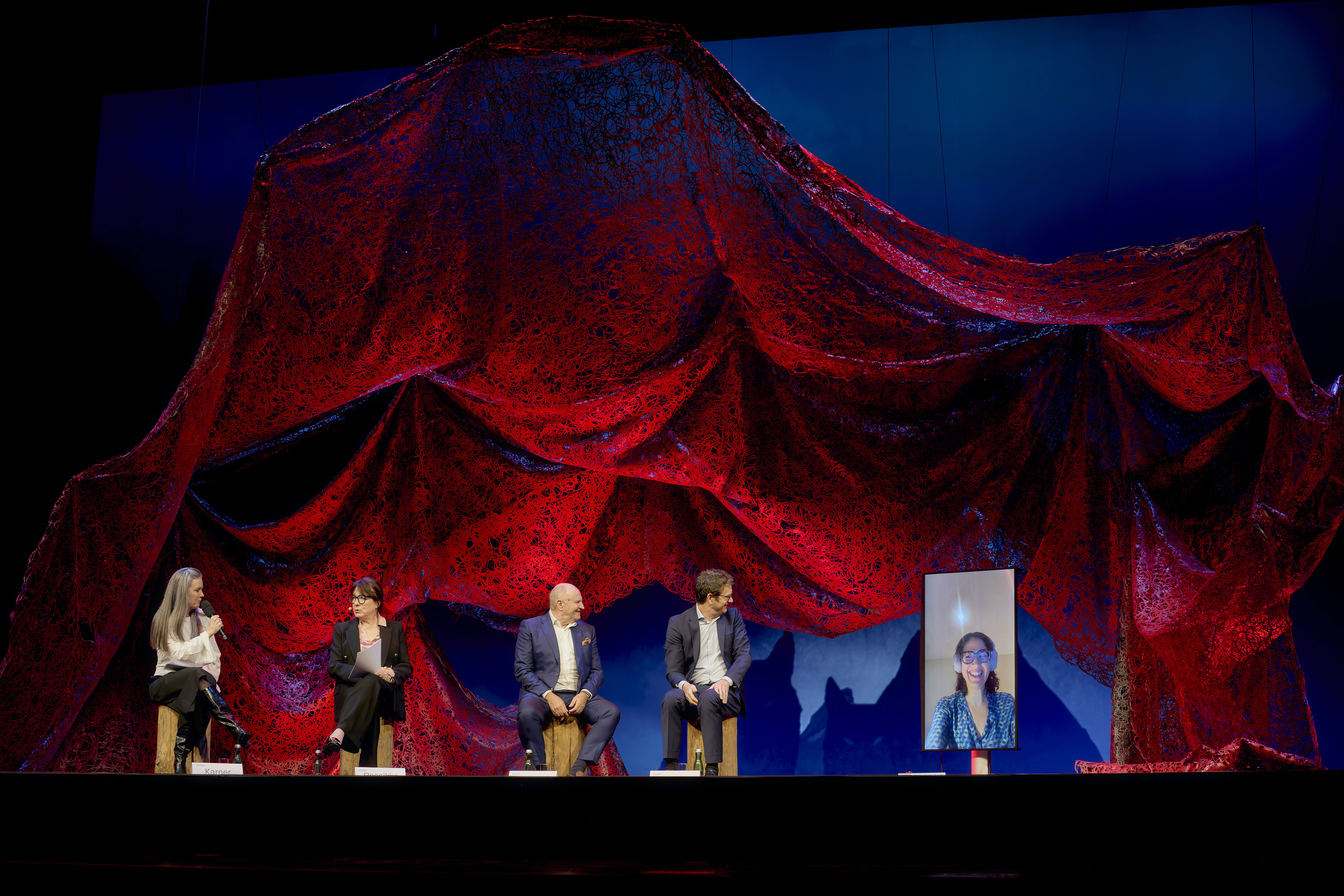
The 2027 festival opens on 21 July with Othmar Schoeck’s Penthesilea at the Festspielhaus. The festival is staging a new production of this gripping, yet rarely performed piece one hundred years after its world premiere. It also marks the 250th anniversary of the birth of Heinrich von Kleist, whose play the opera is based on. The story of the queen of the Amazons and the Greek hero Achilles tells of a love that is defeated by the conflict between the feelings of the individual and the laws of the community, and ultimately descends into destructive violence. Stage director Mariame Clément stages the piece in an abstract space reminiscent of a courtroom, a parliament and an anatomical theatre. The production will be conducted by Kristiina Poska with sets and costumes designed by Julia Hansen.
In Songs from the Abyss, stage director Ruth Brauer-Kvam offers an evening of music theatre exploring social constraints, war and violence (30 and 31 July) at the Werkstattbühne, with a double bill of Kurt Weill and Bertolt Brecht’s The Seven Deadly Sins and Georges Aperghis’s Le Soldat inconnu. In his multimedia film-opera Theory of Flames, Michel van der Aa explores how conspiracy theories and alternative explanations alter a person’s perceptions and even human relationships (12 and 13 August).
The Opera Studio will move to the town of Götzis in 2027. In the Kulturbühne AMBACH, Vera Nemirova will direct Mozart’s The Abduction from the Seraglio as a piece about love, power and dependency – the seraglio becoming a film set, Konstanze a young actress, and Bassa Selim a powerful director. The production opens on 16 August.
The orchestral concerts embrace a wide range of music from Beethoven, Brahms and Bartók to the Great American Songbook. The Vienna Symphony Orchestra will play under Domingo Hindoyan with clarinettist Martin Fröst (26 July), under Giedrė Šlekytė with mezzo-soprano Ekaterina Gubanova (1 August) and under Petr Popelka with pianist Alice Sara Ott (8 August). Broadway and Hollywood are the destination in a concert given by the Vorarlberg Symphony Orchestra with the soprano Camilla Nylund (22 August). In a special concert, star tenor Juan Diego Flórez performs together with the Sinfonía por el Perú youth orchestra – a social project that he founded (3 August).
Among the diverse highlights of the chamber music programme are Verdi’s only string quartet, Schoenberg’s Pierrot lunaire and musical boundary-crossing with the Finnish brass sextet Kolizio. There’s also a welcome chance to hear the vocal ensemble Amarcord, the mezzo-soprano Anja Mittermüller and accordionist Janne Valkeajoki.
At the Young People’s Festival, a little apprentice chef has to conjure up the perfect polenta soufflé in the exciting musical Polenta, Polenta, Polenta! Young musicians will show off the results of the International Wind Music Camp in a concert entitled Brass drammatico. Young People’s Night, the Children’s Festival, opera workshops and a STEM project involving Rieden Secondary School will give youngsters plenty of opportunities to engage with music and theatre.
The 2027 Bregenz Festival runs from 21 July to 23 August. For tickets and information, please visit www.bregenzerfestspiele.com or call tel. 0043 5574 4076.
Opera on the lake: When the illusion shatters
Giuseppe Verdi’s La traviata will be returning to the lake stage following an exceptionally successful first run in the summer of 2026. All 28 performances were sold out, with around 193,500 people seeing the opera staged against the backdrop of Paolo Fantin’s monumental mirror wall, shattered into countless fragments. The second run of Damiano Michieletto’s production opens on 22 July 2027. Due to popular demand, the Bregenz Festival has been extended by one day – a total of 29 performances are now scheduled up to Monday, 23 August.
Verdi’s opera centres on the Parisian courtesan Violetta Valéry, who lives in a world of luxury, lavish parties and social conventions. When she meets the young Alfredo Germont, a different life in which she may have more autonomy seems possible. Yet their love is under pressure from society’s expectations: Alfredo’s father demands that Violetta end the relationship to protect his family’s reputation. Violetta makes the sacrifice without revealing the true reason for her decision to Alfredo. It’s only when her serious illness is already at an advanced stage that the truth comes to light.
Stage director Damiano Michieletto has set the story in the Roaring Twenties – a dazzling world of lavish parties, glamour and hunger for life, whose glittering façade casts a harsh light on Violetta’s loneliness and her longing for true love. The centrepiece of Paolo Fantin’s set design is a gigantic, shattered mirror, which operates simultaneously as a performance space, a projection screen, and an image of the shattering of Violetta’s dreams. The tragedy of her story is compacted in a disturbing visual metaphor when, at the end, a huge black sphere emerges from the fragments like an ominous symbol of fate.
The music directors of La traviata are Pietro Rizzo and James Sherlock. Stage director Damiano Michieletto and stage designer Paolo Fantin are joined in the production by costume designer Carla Teti, lighting designer Alessandro Carletti, with video sequences by Roland Horvath and choreography by Thomas Wilhelm.
Opera at the Festspielhaus: Love in defiance of the tyranny of order
At the Festspielhaus, the Bregenz Festival will be staging a rarely performed masterpiece of 20th century music theatre: Othmar Schoeck’s Penthesilea. The curtain goes up on the new production on 21 July, officially opening the 2027 festival. The gripping opera is being staged at Bregenz one hundred years after its world premiere in Dresden in 1927; it also marks the 250th anniversary of the birth of Heinrich von Kleist, whose play the opera is based on.
The story takes place during the Trojan War. Penthesilea, the queen of the Amazons, falls in love with the Greek hero Achilles. But according to Amazon law, she can only enter a relationship with a man who she has defeated in battle. Achilles reciprocates her feelings and tries to ensure their future partnership by feigning defeat. A fatal misunderstanding causes the situation to escalate. Descending into an uncontrollable frenzy, Penthesilea kills Achilles, before realising the full extent of her actions.
The Swiss composer Othmar Schoeck – known primarily as a composer of art songs – condensed Kleist’s tragedy Penthesilea, long considered unperformable, into an approximately 80-minute, one-act opera of extraordinary musical intensity, which moves between late Romantic expressiveness and the soundscapes of modernism.
Schoeck focuses exclusively on the decisive stages of the relationship between Penthesilea and Achilles, dispensing with the periodic relieving of tension that is customary in grand opera. The result is a virtually unbroken arc of musical intensity, in which sung and spoken passages alternate and lyrical moments are juxtaposed with explosive outbursts. The instrumentation is unusual as well. Instead of a large late-Romantic string section, Schoeck employs ten clarinets, a range of percussion instruments, a piano and only a few strings. This orchestration imbues the work with an archaic, sombre atmosphere, in which even the distant rumble of war can be heard.
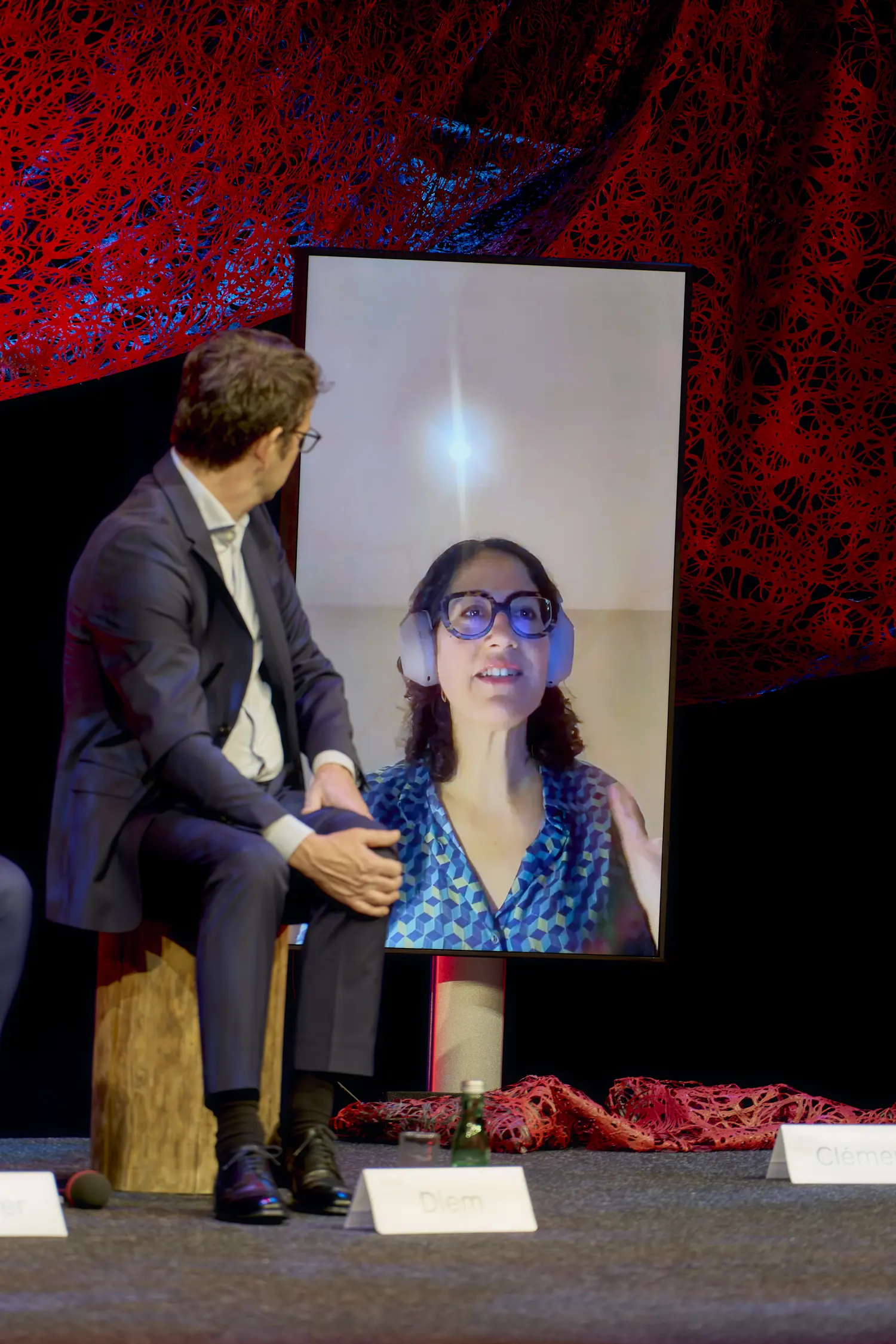
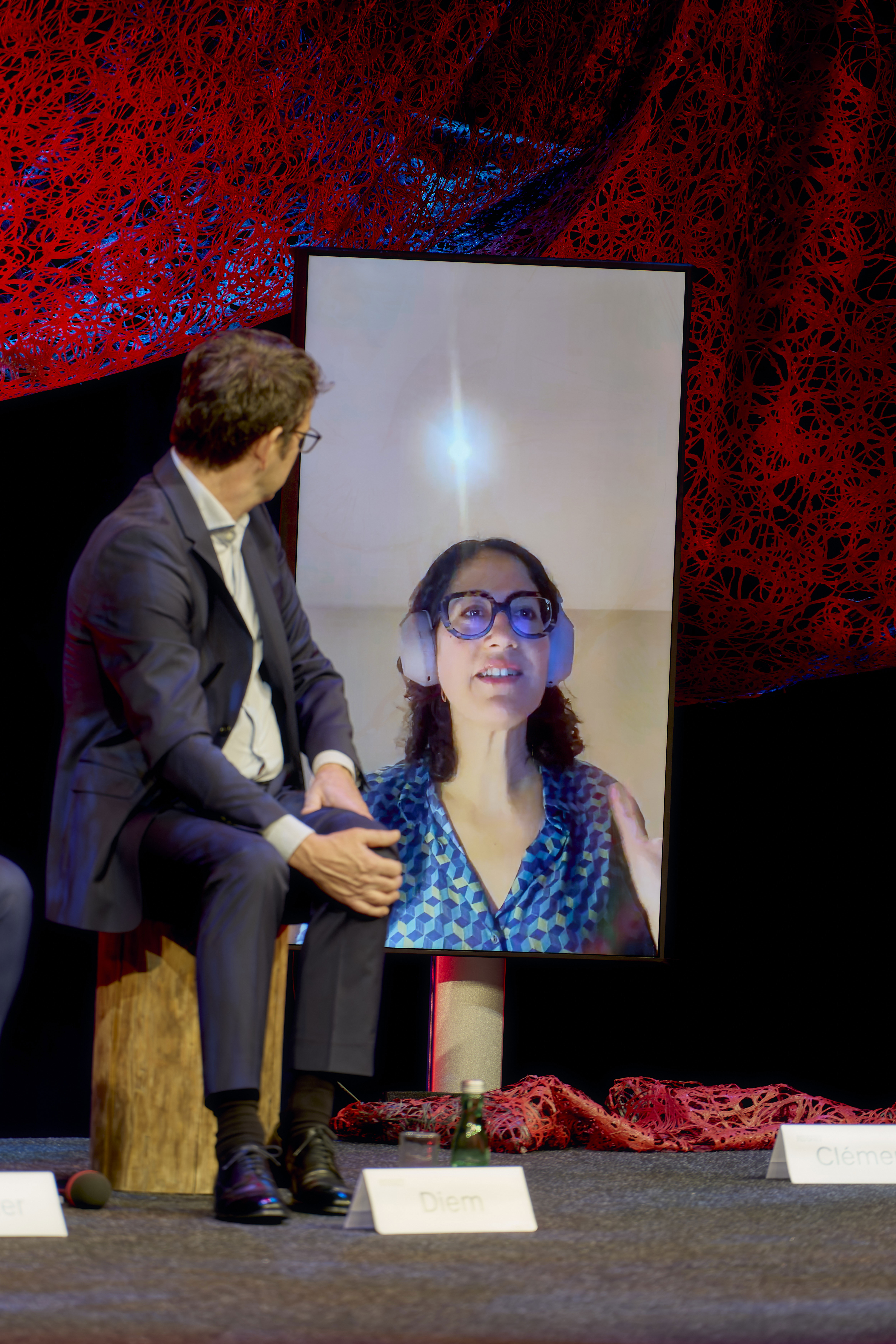
The French director Mariame Clément, who previously staged Massenet’s Don Quichotte at Bregenz in 2019, has teamed up with set and costume designer Julia Hansen to create an abstract space that oscillates between an anatomical theatre, a courtroom and a parliament and at the same time is reminiscent of a mortuary. Here, the conflicts between the individual’s pursuit of happiness, social constraints and destructive passion are, as it were, dissected. The musical director will be the Estonian conductor Kristiina Poska. The production is consequently in the hands of an all-female artistic team, which explores questions of power, autonomy and violence beyond traditional gender roles.
Music theatre at the Werkstattbühne: War, illusion, reality
The two productions in the Werkstattbühne theatre space in 2027 both address contemporary social and political issues. Songs from the Abyss is a production that explores the causes and consequences of war and violence, while Michel van der Aa’s film-opera Theory of Flames probes the boundaries between reality, perception and digitally generated realities.
Songs from the Abyss: The mechanisms of war
Songs from the Abyss on 30 and 31 July 2027 is a double bill that consists of two musically and dramatically different works: Kurt Weill and Bertolt Brecht’s The Seven Deadly Sins and Georges Aperghis’s Le Soldat inconnu. Austrian director Ruth Brauer-Kvam, in collaboration with the Ensemble Modern, brings them together in an evening of music theatre that explores social constraints, the destructive mechanisms of violence and their consequences for the individual.
In The Seven Deadly Sins from the year 1933, Brecht and Weill send their protagonist, Anna, on a journey through seven American cities. Her aim is to earn money so that her family can build a house. In the process, she has to subordinate her personal needs and feelings to economic expectations. To the sound of cabaret, jazz and light music, Brecht and Weill turn morality on its head. In this work of trenchant social criticism, it’s not exploitation and ruthlessness that are portrayed as sins, but human sensibility that stands in the way of commercial success.
Georges Aperghis’s Le Soldat inconnu, composed in 2013, draws on Franz Kafka’s parable The City’s Coat of Arms. In it, a community fails in its attempt to erect a colossal tower; the pursuit of greatness and superiority gives rise to rivalry, destruction and war. The central figure of Aperghis’s work is a nameless soldier whose traumatic experiences are imprinted even in language. The words he utters fragment into sounds and syllables; repetitions and silences make the impossibility of communication audible.
Theory of Flames: Perception or reality?
What happens when people can no longer distinguish between established facts and their personal conception of reality? The Dutch composer, director and librettist Michel van der Aa explores this question in his film-opera Theory of Flames, a multimedia music theatre work that can be seen at the Werkstattbühne on 12 and 13 August 2027.
The piece follows the filmmaker Neola, who is working on a science-fiction film about a devastating laboratory fire. During her research, she becomes increasingly entangled in a web of alternative explanations and conspiracy theories. Her perception progressively alters until even her relationships with her partner Marianne and her friend and cameraman Josh begin to suffer.
Michel van der Aa combines live camera, filmed sequences, stage action and music to create a multi-layered narrative. The different levels of reality overlap, with recorded and live scenes blending into one another. Musically, too, the work transcends genre boundaries: electronic sounds, orchestral passages, rock elements and lyrical moments coalesce to form a unique soundscape.
The music director of the production is the Swiss-Australian conductor Elena Schwarz. Michel van der Aa not only wrote the music and the libretto but is also the stage director. His idiosyncratic fusion of film and music theatre is already familiar to Bregenz audiences from the opera Upload, which was staged at the Werkstattbühne in 2021.
Opera Studio at the Kornmarkt: Mozart on the film set
Due to renovation work at the Theater am Kornmarkt, the Opera Studio will move to Kulturbühne AMBACH, a theatre and event centre in the nearby town of Götzis in 2027. Next year’s production will be The Abduction from the Seraglio by Wolfgang Amadeus Mozart. For a contemporary interpretation of the comic opera, Bulgarian-German director Vera Nemirova, together with set and costume designer Tanja Hofmann and video designer Martin Schmidt will make full use of the unique features of this venue – a former cinema building with a large auditorium. Katharina Müllner will be music director of the production, which opens on 16 August.
A turbulent love story with an oriental flavour and touching on questions of power, freedom and forgiveness, Mozart’s The Abduction from the Seraglio proved to be a sensational success at its premiere in 1782. The Singspiel – with spoken dialogue, in German – reflects a fascination with the Orient that characterised late 18th century Europe. It tells the story of Belmonte, who attempts to free his fiancée Konstanze from captivity after she has been abducted by pirates. Her captor Bassa Selim, however, has fallen in love with Konstanze himself and does all he can to win her affections.
In stage director Vera Nemirova’s production, Mozart’s The Abduction from the Seraglio is transposed from the Orient of the 18th century into the film business of our own day: the seraglio (palace, harem) becomes a film set, Konstanze an ambitious young actress, and Bassa Selim a charismatic, powerful director under whose dubious influence she finds herself. The orientalism of the historical source material appears as a film set, in this production, and is thus held up for scrutiny itself. In this world where glamour, dependency and intergenerational power dynamics collide, the question that urgently needs to be answered is: does Konstanze even want to be rescued?
Orchestral concerts: from Beethoven to Broadway
The Bregenz Festival’s orchestral concerts in 2027 span a wide range from Bartók and Beethoven, Brahms and Wagner, via opera arias to the unforgettable melodies of American Broadway and Latin American songs. International conductors and soloists will join forces with renowned orchestras to present a richly varied programme of concerts.
The first orchestral concert by the Vienna Symphony Orchestra, on 26 July at 7.30 pm, will be conducted by Domingo Hindoyan, the new music director of the Los Angeles Opera. The spotlight will be on the Swedish clarinettist Martin Fröst, for whom Anders Hillborg has composed his clarinet concerto Peacock Tales, a work that is as virtuosic as it is theatrical. In this piece, Fröst will display his abilities not only as a musician but also as a dancer and actor. The same concert first takes the audience into the world of classical mythology with Carl Nielsen’s tone poem Pan og Syrinx, and is brought to a close by Béla Bartók’s Concerto for Orchestra, dating from 1943 when the composer was in exile in the United States.
At the orchestral matinee on 1 August at 11.00 am, the Lithuanian conductor Giedrė Šlekytė will focus on two composers who, despite their differing musical views, held each other in high regard: Richard Wagner and Johannes Brahms. With the “Prelude and Liebestod” from Tristan und Isolde and the Wesendonck Lieder, we will hear two closely related works by Wagner that tell of love and insatiable longing. The soloist will be the internationally acclaimed mezzo-soprano Ekaterina Gubanova. The programme concludes with Johannes Brahms’ Fourth Symphony in E minor, a high point in his symphonic output.
To mark the 200th anniversary of Ludwig van Beethoven’s death, the Vienna Symphony Orchestra will dedicate an orchestral matinee to the composer on 8 August at 11.00 am, conducted by their principal conductor Petr Popelka. Pianist Alice Sara Ott will perform Beethoven’s Third Piano Concerto in C minor. The concert also features the dramatic Coriolan Overture and the Fourth Symphony in B flat major, which is characterised by lightness, humour and joie de vivre. The programme showcases different facets of the composer, whose works have been closely linked to the history of the Vienna Symphony Orchestra since its foundation.
At its orchestral matinee on 22 August at 11.00 am, the Vorarlberg Symphony Orchestra will transport the audience into the world of swing and jazz from the 1930s to the 1950s. In a concert celebrating the Great American Songbook, the acclaimed Kammersängerin Camilla Nylund will perform classics by George Gershwin, Cole Porter, Irving Berlin and Richard Rodgers, including “Almost Like Being in Love” and “There’s No Business Like Show Business”. Specially arranged orchestral versions will lend new splendour to the familiar melodies from Broadway shows and Hollywood films. At the podium is the Welsh conductor Nick Davies, who can look back on a long career in musicals and on London’s West End.
The Peruvian star tenor Juan Diego Flórez will appear at a special afternoon concert on 3 August at 4 pm together with the Sinfonía por el Perú youth orchestra. This social project, founded by Flórez in 2011, provides free musical education to around 10,000 children and young people in Peru. Under the baton of Elizabeth Vergara Gallego, the young musicians will play alongside Flórez, performing opera arias and overtures by Bellini, Donizetti and Verdi, as well as zarzuela romances and Latin American songs.
Chamber music: Verdi, waltzes and unusual sounds
The chamber music programme of the 2027 Bregenz Festival takes audiences on a journey through a wide range of eras, styles and musical worlds at the Lake Studio (Seestudio), the Kunsthaus Bregenz and St Martin’s Chapel.
On 31 July at 7 pm in the Lake Studio, the Glière Quartet of the Vienna Symphony Orchestra brings together two composers who could scarcely be more different: Alexander von Zemlinsky, who had already found his expressive and humorous voice in his first string quartet, and the giant of opera Giuseppe Verdi, who permitted himself a little “amusement” with his sole foray into the realm of the string quartet.
On 7 August at 7 pm, the Vienna Symphony Orchestra’s principal conductor, Petr Popelka, will show his chamber music side. Together with his wife, the mezzo-soprano Christina Bock, and musicians from the orchestra, he will be performing, amongst other works, Arnold Schoenberg’s Pierrot lunaire. This seminal work of modernist music, with its unusual combination of spoken recitation and instrumental music, leads the listener into the bizarre world of Pierrot, which swings between melancholy and the grotesque.
By contrast, a dash of Viennese summertime joie de vivre can be heard in the concert by the Johann Strauss Ensemble of the Vienna Symphony Orchestra on 14 August at 7 pm, featuring swaying waltzes, lively polkas and spirited mazurkas.
With the Finnish brass sextet Kolizio – Esperanto for ‘collision’ – the name says it all. In the sextet’s concert on 1 August at 7 pm, Beethoven, Bach and Copland meet jazz, astonishing arrangements and works composed especially for Bregenz. Musical boundary-crossing is positively encouraged!
At the Kunsthaus Bregenz (KUB), the Leipzig vocal ensemble Amarcord will take the audience on a musical journey through the seasons from the Renaissance to jazz, with their programme Four Seasons on 3 August at 9.00 pm. Austrian mezzo-soprano Anja Mittermüller and pianist Richard Fu will dedicate their recital Sehnsüchte der Romantik (“Longings of Romanticism”) to music by Schubert, Wolf and Berlioz in a concert at the Lake Studio on 8 August at 7 pm.
The medieval St Martin’s Chapel in Bregenz’s upper town is an atmospheric setting for two concerts by the Finnish accordionist Janne Valkeajoki on 15 August, at 6.30 pm and 9 pm. She will perform works by Bach, Debussy and Rameau in addition to giving the world premiere of a piece by Lotta Wennäkoski. The New York Times ranked Valkeajoki’s recording of Rameau’s Pièces de Clavecin among the best classical albums of 2024.
Young People’s Festival: Wind music and maize soufflé
A little apprentice chef faces a gigantic challenge in Polenta, Polenta, Polenta! Elias must prepare the perfect polenta soufflé for the dreaded three-star chef Karamelov. Composer Catherine Kontz’s new musical tells a story that’s both humorous and touching about courage, imagination and the astonishing possibilities of a small grain of maize. Produced by the Philharmonie Luxembourg, the musical is a co-production with the ensemble Die Schurken and the Bregenz Festival. It can be seen at the Lake Studio on 20 June for families, and on 21 and 22 June for nursery and school groups.
Under the title Brass drammatico, young musicians from various countries, together with tutors from the Vienna Symphony Orchestra, will show off the results of the 8th International Wind Music Camp. The camp concludes with a concert on 15 August in the Great Hall of the Festspielhaus. On the bill are pieces by Verdi, Grieg, Elgar and Khachaturian, amongst others. Martin Kerschbaum will conduct.
The Young People’s Festival aims to inspire young people with a love for music and theatre, and to give them direct access to the world of the festival. It’s not just about watching, but about taking part above all. At the Children’s Festival, 200 children will create their own stage show, while Young People’s Night on 17 July promises a varied programme plus a group visit to La traviata on the lake stage. There are backstage tours offering a glimpse behind the scenes, and opera workshops for stagecraft and performance where youngsters get to act on stage themselves.
Just how closely art and technology are linked is demonstrated by a STEM project involving Rieden Secondary School. Here, the pupils develop their own play, designing the set and also taking charge of the technical side of the performances, which will take place at the Festspielhaus in early July.